
Published: March 2026 · Reading time: 12 minutes
The majority of HVAC company websites have the same content problem: a handful of thin service pages, a blog that was updated three years ago with generic “tips for summer AC maintenance” articles that rank for nothing, and no content architecture connecting any of it to the phone calls the business needs.
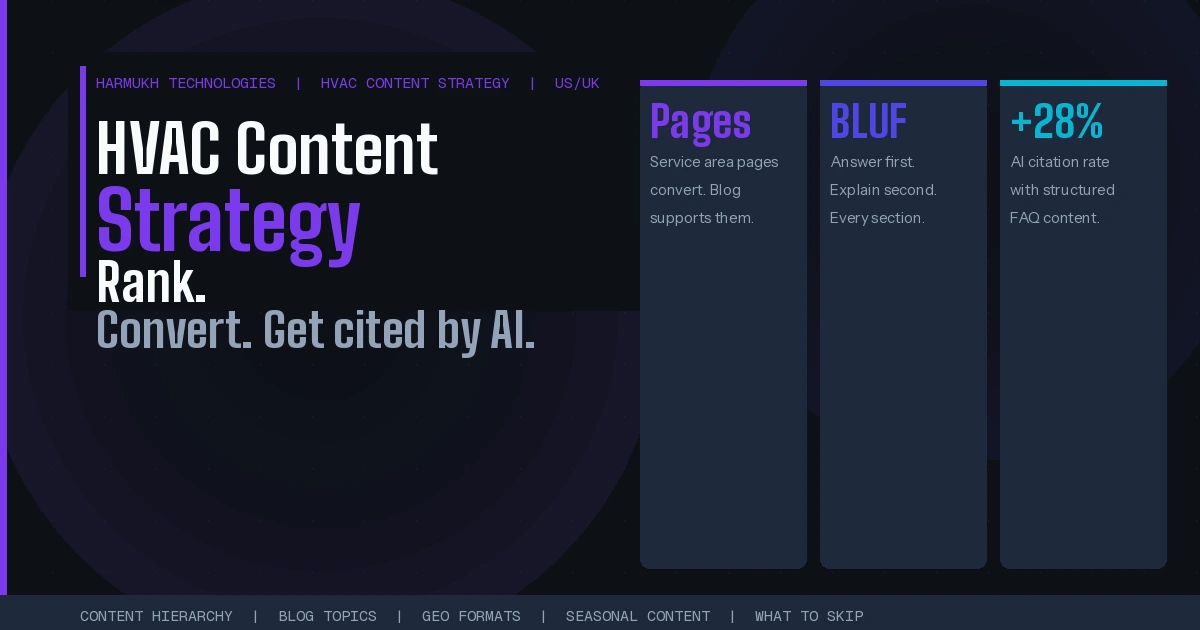
HVAC content strategy in 2026 has a clear logic. Service area pages convert homeowners into booked jobs — they are the commercial core of the website. Blog content answers the pre-hire questions homeowners research before deciding to call, builds topical authority, and feeds traffic into those service pages. GEO content gets your answers cited by AI systems, creating brand awareness before the homeowner even reaches Google. Seasonal content captures predictable demand spikes by publishing weeks before the peak.
Everything else — company news, generic HVAC history articles, duplicate city pages — wastes content budget and dilutes the topical authority your site needs to rank for competitive service area queries. This guide gives you the complete HVAC content framework: what to build first, what to write, what to stop writing, and how to audit and fix the content that’s already on your site producing nothing.
What This Guide Covers
- The HVAC content hierarchy: service pages, blog, GEO, seasonal
- High-value blog topics for HVAC companies
- What to stop producing immediately
- GEO content formats that get cited by AI systems
- Seasonal content: the timing strategy that captures peak demand
- Service area page anatomy: the elements that book the job
- Content audit: what to do with your existing HVAC content
- Frequently asked questions about HVAC content strategy
The HVAC Content Hierarchy
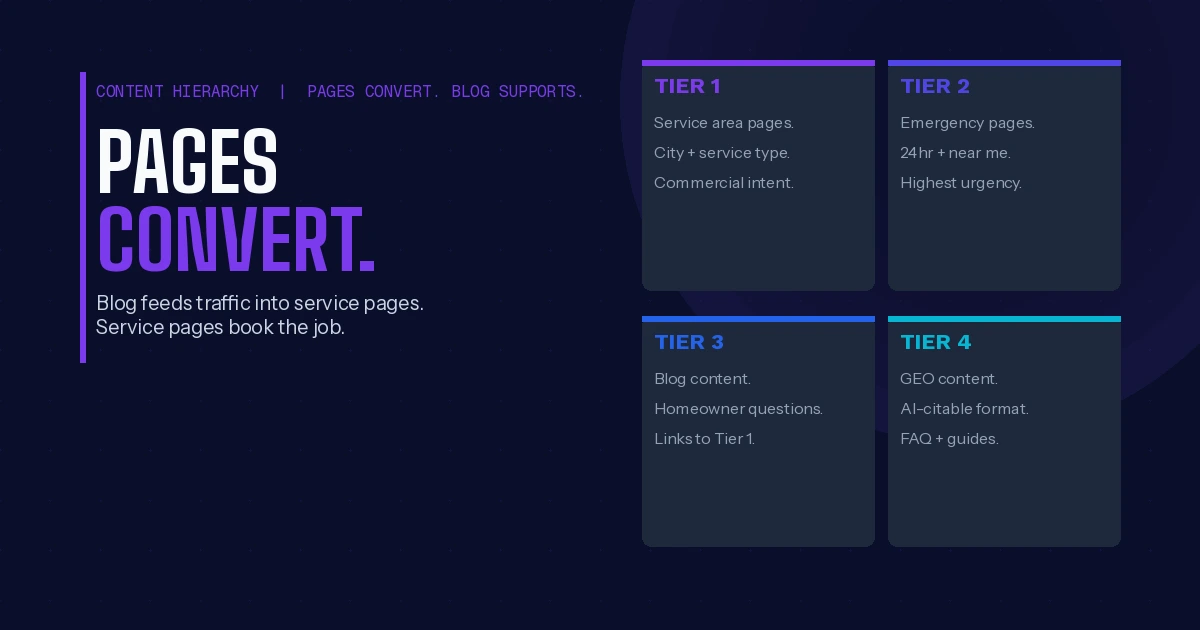
HVAC website content operates in four tiers, each with a distinct function and success metric. Most HVAC companies produce Tier 3 content (generic blog posts) while underinvesting in Tier 1 (the service area pages that actually book jobs) — then wonder why their content investment doesn’t convert to revenue.
Tier 1: Service area pages — the commercial core
One dedicated page per service type per city: “AC Repair Chicago,” “Furnace Repair Chicago,” “Heat Pump Installation Chicago,” and so on for every service type you offer across every city you serve. These are commercial-intent pages with a single goal: book a job. They are dense (500–800 words), direct (phone number and booking form above the fold), and loaded with conversion signals: licence number, certifications, recent reviews, and a clear contingency or pricing statement. Every other content type on the site exists to support and feed traffic into these pages.
Tier 2: Emergency and specialty pages
“Emergency AC Repair Chicago,” “24-Hour Furnace Repair Chicago,” “Commercial HVAC Chicago” — these are distinct-intent pages that require their own dedicated content rather than being served by Tier 1 pages. Emergency pages have a different conversion architecture (phone number as primary element, same-day promise above the fold) and target a distinct query modifier that Tier 1 pages don’t fully address.
Tier 3: Blog and FAQ content
Informational content targeting pre-hire questions: “why is my AC not cooling,” “how much does furnace repair cost,” “should I repair or replace my AC.” This content captures homeowners in the research phase, builds topical authority for the service area queries your Tier 1 pages target, and converts research-intent traffic into service page visits via internal links. Every Tier 3 piece must include at least one contextual internal link to a Tier 1 service page.
Tier 4: GEO content
Structured content specifically formatted for AI citation — FAQ pages, diagnostic guides, cost breakdowns, decision frameworks. This content is often built as a component of Tier 3 articles (an FAQ section within a blog post) rather than standalone pages, though dedicated FAQ and guide pages can also serve this function independently.
High-Value Blog Topics for HVAC Companies
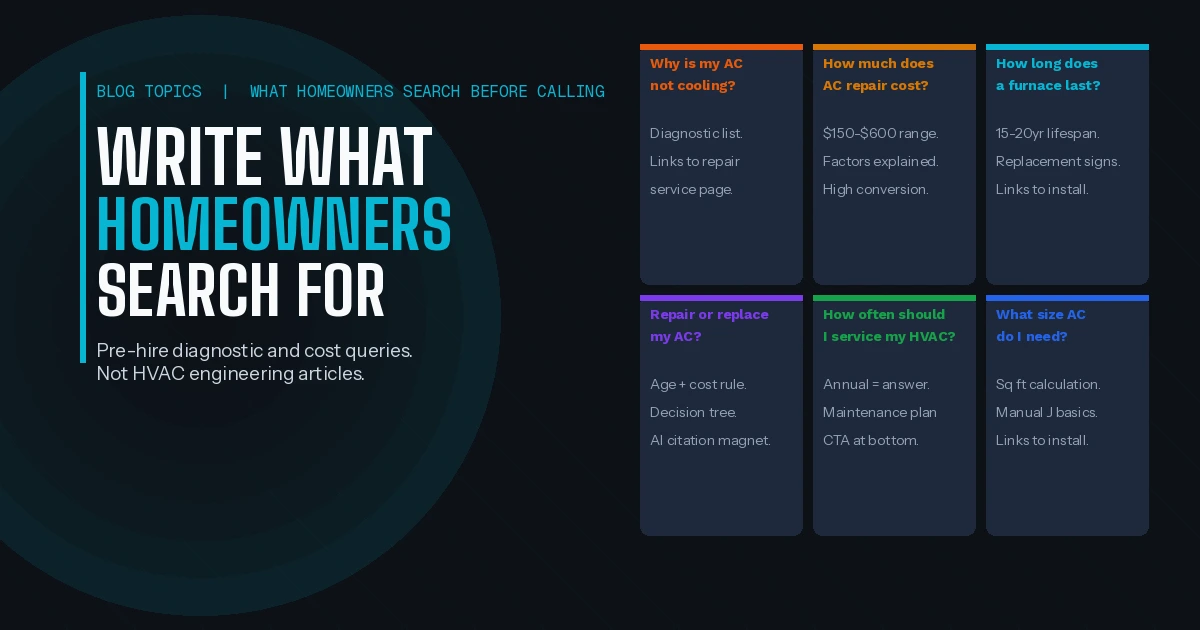
The highest-value HVAC blog topics are the questions homeowners research in the hours and days before they decide to call a contractor — not HVAC engineering content, not company news, and not generic maintenance tips. The pre-hire research questions are where intent transitions from informational to commercial, and a blog article that answers them well with a clear internal link to the relevant service page captures that intent transition.
Diagnostic questions: the highest-conversion blog type
“Why is my AC not cooling?” is searched at high volume every summer by homeowners who are about to call an HVAC company — they just want to understand what’s wrong first. An article that answers this question with a step-by-step diagnostic (seven possible causes, what to check for each, when each requires professional service) both ranks well for diagnostic queries and converts well because the article’s final step is a recommendation to call a professional, with an internal link to the AC repair service page. The same framework applies to “why is my furnace not turning on,” “why is my AC making noise,” and equivalent diagnostic queries for every equipment type you service.
Cost questions: the most-searched, least-answered topic
HVAC cost content is systematically underproduced by HVAC companies — most contractors are reluctant to publish pricing information. This reluctance is a competitive content opportunity: “how much does AC repair cost,” “what does a new furnace cost,” and “HVAC tune-up cost” are searched at high frequency and are answered vaguely or not at all by most HVAC company websites. An article that provides specific ranges, explains the factors that determine where in the range a job falls, and describes what is included in a service call fee will rank for high-conversion cost queries and get cited by AI systems that handle the same question for the same homeowners.
Decision questions: the AI citation magnets
“Should I repair or replace my AC?” and “Is it worth fixing an old furnace?” are decision-framework queries where the homeowner has an immediate situation and needs a clear recommendation. Articles that provide a specific decision rule — “if your AC is over 10 years old and the repair costs more than 50% of replacement cost, replace” — are cited far more reliably by AI systems than articles that provide a balanced “it depends” discussion. The specificity of the recommendation is what makes it extractable and citable. Commit to a framework, explain the reasoning, and note the exceptions.
For the GEO citation mechanics that apply to all these blog formats, our GEO vs SEO guide covers the full AI citation optimisation methodology. If you’re new to the terminology — GEO, AEO, AIO — our GEO, AEO and AIO deep-dive clarifies how they differ and which applies to HVAC content strategy.
What to Stop Producing Immediately
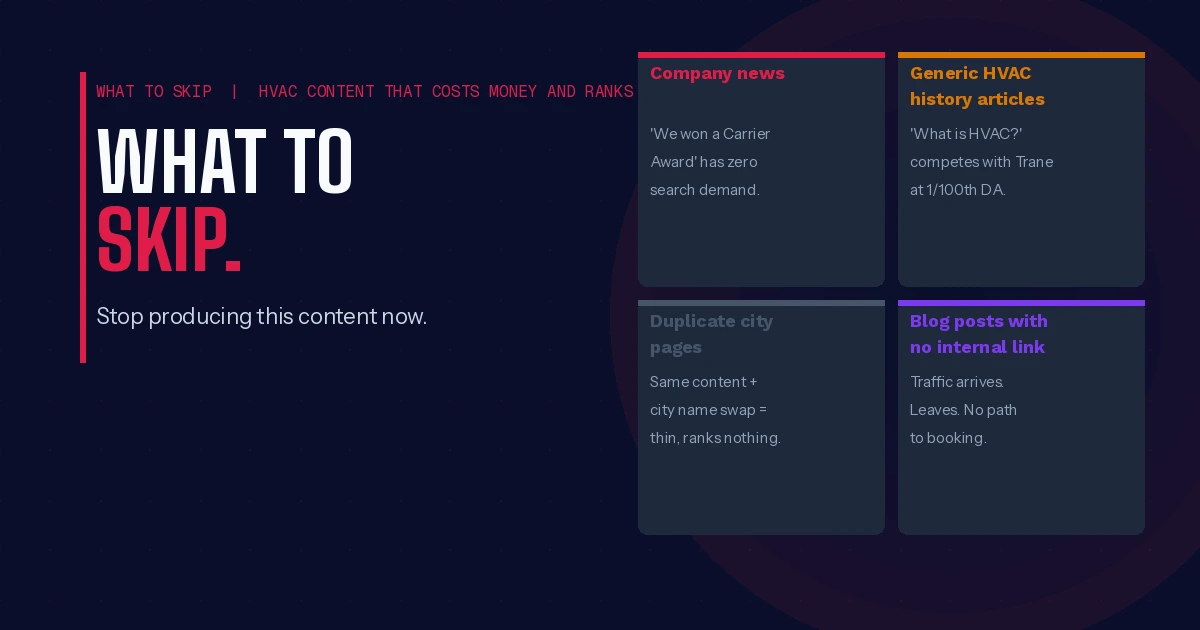
Four HVAC content types consistently consume production budget without producing organic traffic, AI citations, or job bookings. Stop producing any of these immediately and reallocate the budget to Tier 1 and Tier 3 content.
Company news and award announcements
“We’re proud to announce we’ve been named a Carrier Premier Dealer” has zero organic search demand — no homeowner is searching for that query, and it contributes no topical authority to the service area keywords your business needs to rank for. If award announcements need to be published for brand reasons, publish them on a page excluded from Google’s index (add <meta name="robots" content="noindex">) so they don’t dilute topical authority.
Generic HVAC overview articles
“What is an HVAC system?” and “How does air conditioning work?” compete with Trane, Carrier, Energy Star, and HVAC educational sites that have domain authority of 60–80. An HVAC contractor website with a domain authority of 20–35 cannot rank for these queries against those competitors. The traffic from these articles when they do rank is informational-only, from people learning about HVAC who are not currently in the market for a contractor. Stop producing educational overview content that generic authorities already dominate.
Duplicate city pages with swapped location names
An “AC Repair Chicago” page and an “AC Repair Naperville” page that share identical body content — with only the city name in the H1 changed — are thin duplicate content in Google’s evaluation. Google typically ranks neither, because it cannot determine which is canonical for which query. Each city page requires genuinely unique content: references to local neighbourhoods served, local utility rebate programmes specific to that municipality, typical home ages and HVAC system types prevalent in that area, and the specific zip codes or postal codes covered.
Blog posts without internal links to service pages
A blog article that answers a homeowner’s question well but ends without any link to a service page is traffic that arrives and exits without contributing to job bookings. These articles are not worthless — they build topical authority — but they are significantly underperforming their potential. Audit every existing blog article for internal link presence and add at least one contextual link to the relevant service page for any article that lacks one.
GEO Content Formats That Get Cited by AI Systems
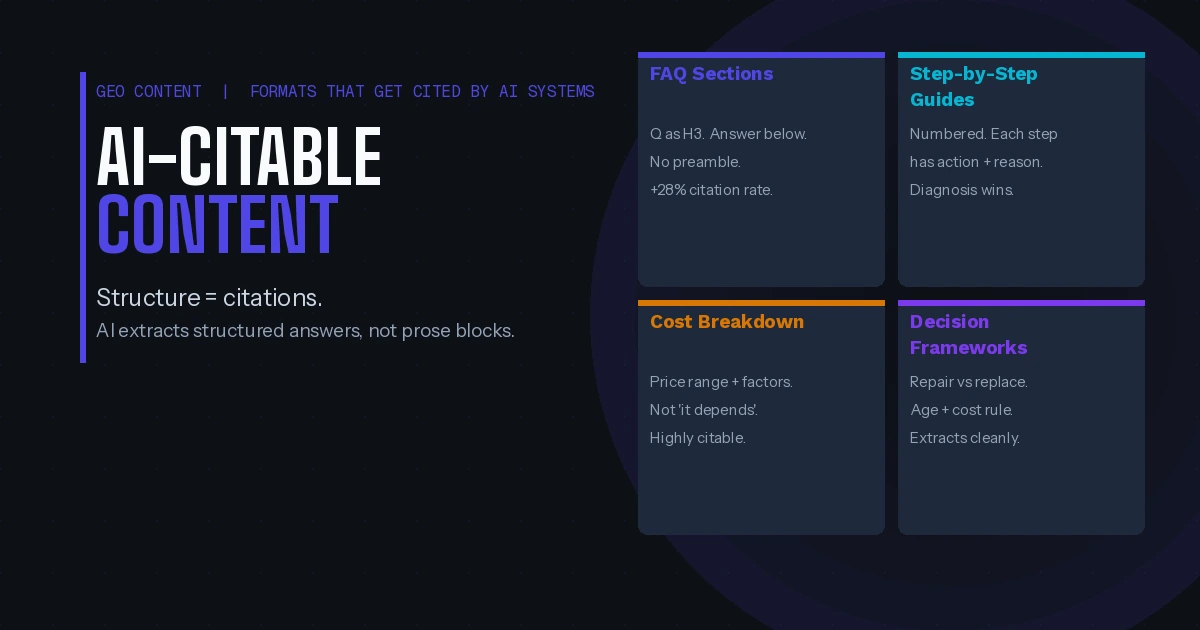
AI systems — ChatGPT, Gemini, Perplexity, Google AI Overviews — extract structured answers from indexed content. They don’t reproduce prose blocks; they extract discrete, structured pieces of information. The content formats that produce AI citations for HVAC queries are the ones that present information in a structure that AI systems can identify and extract cleanly: FAQ format, step-by-step guides, cost breakdowns with specific ranges, and decision frameworks with explicit rules.
FAQ sections: the +28% citation format
Our internal GEO tracking data shows that FAQ sections with FAQPage schema applied receive approximately 28% more AI citation visibility than equivalent information presented as prose paragraphs. The structural requirements are simple: each question as an H3 heading, the complete, direct answer in the paragraph immediately below, no preamble before the answer. “Q: How often should I have my HVAC serviced? A: Annual professional maintenance is recommended — once in spring for the AC system before summer, and once in fall for the heating system before winter.” That answer is extractable. “HVAC maintenance frequency depends on a number of factors that vary by system age and usage…” is not.
Step-by-step diagnostic guides
Diagnostic content structured as a numbered sequence — each cause or step as a numbered item, with a specific check and a clear recommendation — is among the most frequently cited HVAC content types in AI systems. Structure: “Why is my AC not cooling? 7 possible causes. Step 1: Check the thermostat settings. Step 2: Check the air filter…” Each step needs a specific check (what to look for), the likely cause if that check fails, and a clear recommendation (DIY fix or call a professional). This structure extracts cleanly into AI answers for diagnostic queries.
Cost breakdown content
Specific price ranges with factors: “AC repair costs $150–$600 in most US markets. Factors that determine where in that range your repair falls: refrigerant type (R-410A is standard; R-22 is more expensive), part availability, labour rate in your market, and whether the compressor is involved (compressor replacement shifts the range to $800–$2,400).” This is extractable because it provides a framework, not a vague range. AI systems cite it because it’s specific enough to be useful to a homeowner asking the same question.
Seasonal Content: The Timing Strategy That Captures Peak Demand
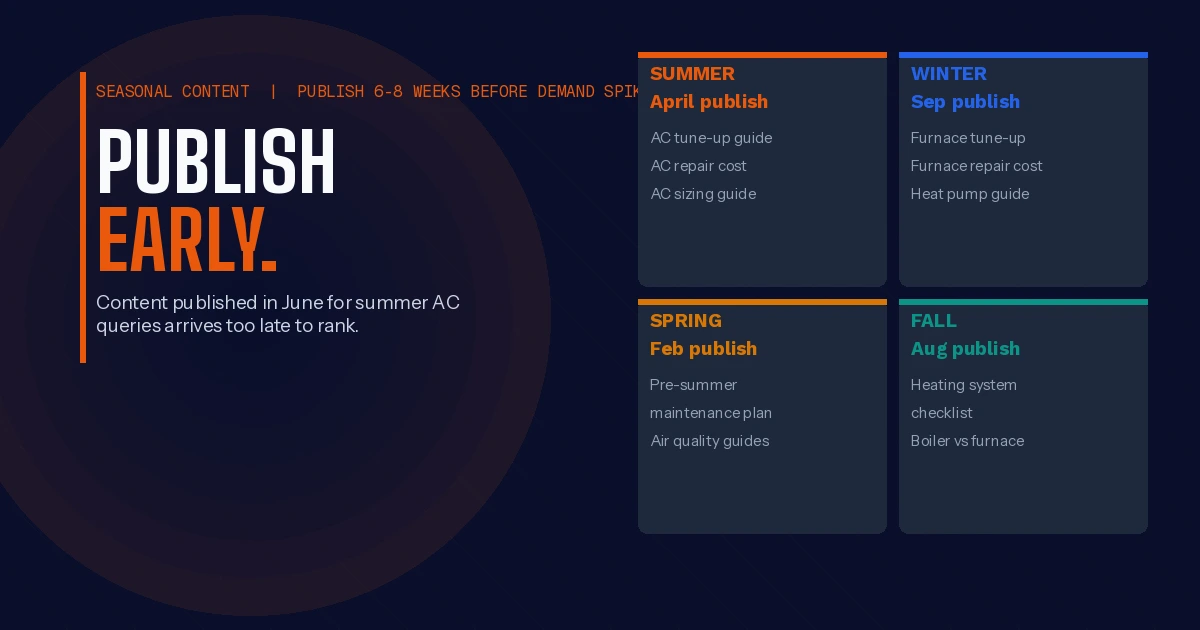
HVAC demand follows a highly predictable seasonal pattern — which creates a repeatable content opportunity that most HVAC companies miss by publishing too late. Google needs 6–8 weeks to index, process, and rank new content for competitive queries. A “summer AC tune-up guide” published in June will not rank meaningfully until August, after most of the summer demand peak has passed. The same article published in April ranks through June, July, and August — the entire peak period.
Summer content: publish in March–April
“Is your AC ready for summer?” maintenance guides, AC tune-up service pages, pre-season energy efficiency guides, and “AC repair cost” articles should all be published or refreshed in March–April. By the time the first heat wave arrives, these pages will have 8–12 weeks of Google indexing behind them and will be positioned to capture the surge in AC-related queries.
Winter content: publish in September–October
Furnace repair guides, heating system tune-up content, “why is my furnace not working” diagnostic articles, and boiler service pages for UK markets should be published or refreshed in September–October. The first cold snap of the season — typically November in northern US markets, October in Scotland and northern England — produces the highest-urgency heating queries of the year. Content that has been indexed since October will rank for these queries; content published in response to the cold snap will not rank until January.
Evergreen seasonal content vs. annual refresh content
Some seasonal content is genuinely evergreen — a “how to prepare your HVAC for winter” guide doesn’t become outdated. Update the date, refresh any statistics, add a new FAQ section, and republish annually. Other seasonal content is tied to specific conditions (utility rebate programmes, equipment model changes, regulatory shifts) and requires more substantial annual updates. Build a content calendar that schedules the review and refresh of every seasonal article 8–10 weeks before its target season begins.
Service Area Page Anatomy: The Elements That Book the Job
An HVAC service area page that ranks well but doesn’t convert is a rankings achievement with no business value. The elements that produce conversions on HVAC service pages are consistent and well-understood — and most HVAC company service pages are missing three or four of them.
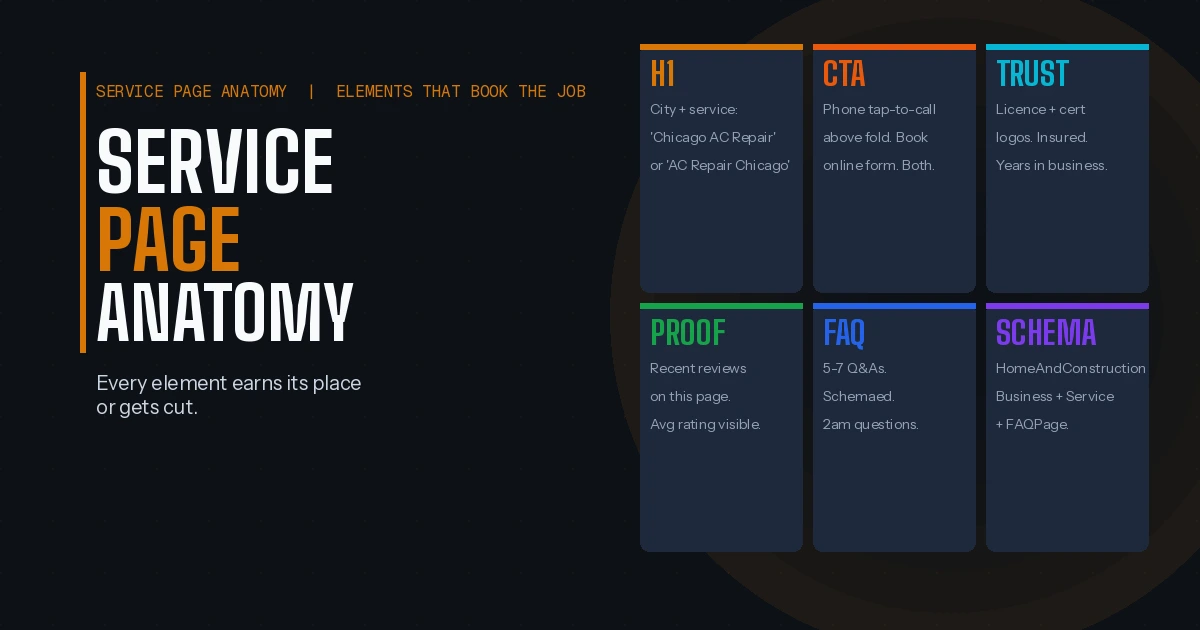
H1: city + service type, in that order
“Chicago AC Repair” or “AC Repair Chicago” — both work, but the city + service type combination must appear exactly in the H1. This is the single most impactful on-page element for local HVAC query ranking. The title tag should match the H1 as closely as possible within 60 characters. Do not add generic qualifiers to the H1 (“Best AC Repair in Chicago,” “Reliable Chicago AC Repair”) — they dilute the query match without adding ranking value.
Above-fold conversion elements
Phone number (tap-to-call on mobile) and a minimal booking form — name, phone, service type, preferred date — must both be visible above the fold without scrolling. Do not make the homeowner choose between calling and booking online; about 60% of HVAC emergency-intent users call, and 40% prefer to submit a form. The availability promise (“Available 24/7 for emergency service” or “Same-day service Monday–Saturday”) should appear immediately adjacent to or below the phone number.
Trust signals: licence, certifications, reviews
Licence number (visible, not buried), NATE certification and manufacturer authorisation logos, and a review widget showing your average rating and most recent reviews are the three trust elements that have the highest impact on call conversion rate from service pages. The licence number is verifiable — homeowners doing due diligence will check it, and a prominently displayed licence number signals that you’re not hiding from verification. The review widget should show your most recent reviews, not just your highest-rated ones; recency builds more trust than curated selection.
FAQ section: the conversion and citation layer
Five to seven questions answering what a homeowner researching your service at 2am is actually wondering — “How much does AC repair in Chicago typically cost?” “How quickly can you come out?” “Do you offer a warranty on repairs?” “Are your technicians NATE certified?” — serve two functions simultaneously: they address pre-conversion objections directly on the page, and with FAQPage schema applied, they qualify the page for AI citation and Google People Also Ask features. Every service area page should include a FAQ section.
Content Audit: What to Do With Your Existing HVAC Content
Most HVAC company websites have existing content that is either underperforming its potential or actively diluting topical authority. Before producing new content, audit what’s already there — because updating a page that already has organic traffic is typically higher ROI than producing a new page from scratch, and removing thin content that ranks for nothing can improve the overall ranking performance of the pages that matter. Our piece on the SEO audit blind spot makes the case for cleanup-first in detail — and is worth reading before starting any new content production. Similarly, our frank take on why churning out blog posts rarely works explains why volume-first content strategies almost always disappoint.
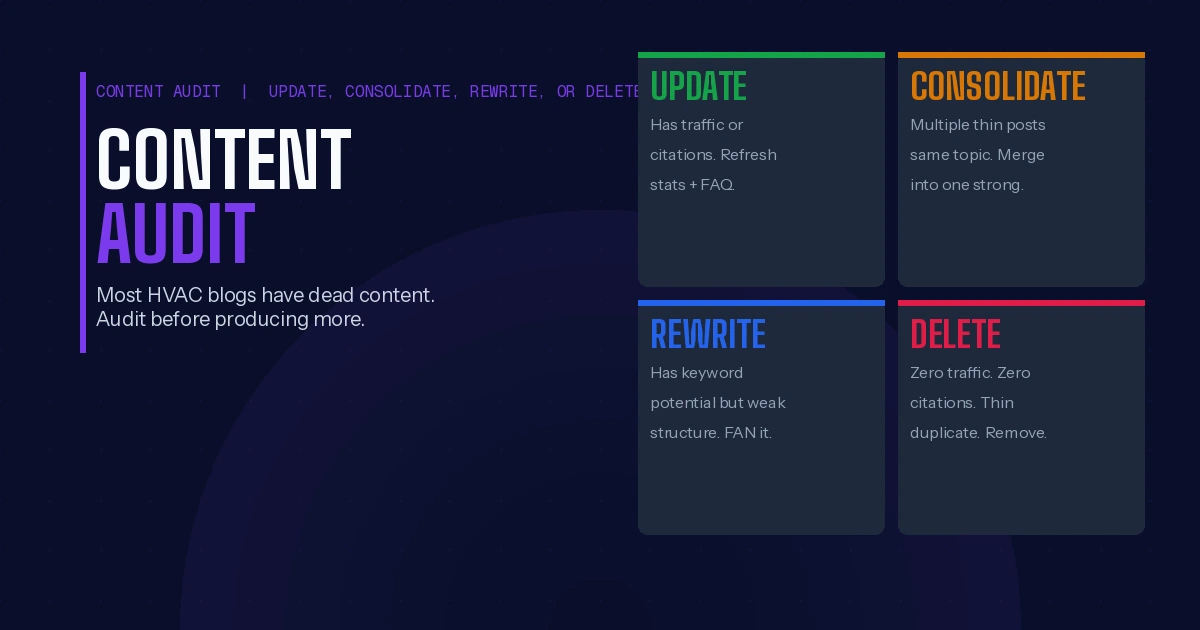
The four-action content audit
Update — for pages that have organic traffic or existing rankings but are factually stale, lack FAQ sections, or have no internal links. Refresh the statistics, add a structured FAQ section with FAQPage schema, add internal links to the relevant Tier 1 service pages, update the date visibly, and re-submit to Google Search Console for indexing.
Consolidate — for multiple thin articles on the same topic. “AC maintenance tips,” “how to maintain your AC,” and “air conditioning maintenance checklist” are three articles that belong as one comprehensive guide. Merge them: 301-redirect the two weaker URLs to the strongest, combine the content into one definitive article, and resubmit. The combined topical authority of three thin articles typically outranks all three individually.
Rewrite — for articles that target valuable keywords but are structurally poor: no BLUF opening, no FAQ section, no internal links, generic language throughout. These articles have potential — they’re targeting the right queries — but aren’t realising it. A FAN-methodology rewrite (BLUF structure, specific data points, structured FAQ, internal links) typically produces significant ranking improvement within 60–90 days for articles that have been stagnant.
Delete (or noindex) — for pages with zero organic traffic, zero keyword ranking, no conversion function, and no topical authority value. Generic HVAC overview articles that rank on page 4 for no valuable query, company news from three years ago, duplicate city pages with swapped content. Remove these from Google’s index. Thin content that consumes crawl budget without contributing ranking or conversion value is a net negative on site-wide topical authority.
Frequently Asked Questions About HVAC Content Strategy
How many service area pages does an HVAC company website need?
One per service type per city actively served. A company with six service types serving eight cities needs 48 service area pages — each with unique content. Start with your highest-volume city and highest-urgency service type (AC repair), then expand systematically. Quality and uniqueness of each page matters more than total page count — 20 well-built unique pages outperform 80 thin pages with swapped city names.
How long should HVAC blog posts be?
The correct length answers the target query completely and specifically with no padding. Most homeowner pre-hire questions are answered well at 700–1,100 words. Diagnostic guides that cover multiple causes may justify 1,200–1,500 words. Generic long-form content produced to hit a word count is the most common form of HVAC content waste. Use BLUF structure throughout — answer each sub-question immediately before explaining it — and stop when you’ve covered what needs to be covered.
Should HVAC companies publish their pricing online?
Yes — cost content is among the most-searched HVAC topics and among the least-covered by HVAC company websites. Publish specific price ranges with the factors that affect where in the range a job falls. You are not committing to a specific price — you are providing a framework that builds trust with homeowners doing pre-hire research and that gets your content cited by AI systems. HVAC companies that publish cost content consistently generate more inbound calls from better-qualified homeowners who have already calibrated their expectations against your ranges.
How do you measure whether HVAC blog content is working?
Track organic traffic per article in Google Search Console, and in GA4 track the path from blog article to service area page (using the Exploration report with a “blog → service page” path sequence). The primary success metric for Tier 3 blog content is organic traffic that subsequently visits a Tier 1 service page within the same session — this is the conversion architecture working. Secondary metrics: ranking positions for target keywords, and for GEO content, citation frequency in ChatGPT and Gemini tested monthly for your target pre-hire queries.
How often should HVAC service area pages be updated?
At minimum quarterly — add new case results or reviews, update certification badges if changed, refresh any seasonal content within the page (e.g., a summer AC promotion or a winter heating maintenance offer). For the highest-priority pages (AC repair and furnace repair in primary cities), monthly review ensures the page stays current as your review profile grows and as any local context (new rebate programs, local utility changes) warrants addition. Always update the “Last reviewed” date visibly on the page — this is a freshness signal to both AI systems and human readers.
The HVAC Content Playbook, Condensed
Service area pages first — one per service type per city, with unique content, conversion elements, and schema. Emergency and specialty pages second. Blog content third — pre-hire questions, cost content, diagnostic guides, each with an internal link to a service page. GEO content fourth — FAQ sections, step-by-step guides, cost breakdowns structured for AI extraction. Seasonal content throughout — published 6–8 weeks ahead of each demand peak. And content audit before all of it — fix what’s there before adding more. For the on-page optimisation mechanics that apply to every page in this stack, our complete on-page SEO guide covers titles, headings, internal links, and schema in detail. And for the AI tools that accelerate content research and production within this framework, our AI SEO tools guide for 2026 is the reference to use.
Want an HVAC content strategy built around job bookings?Harmukh Technologies builds HVAC content programs that start with an audit of your existing site, identify the highest-value content gaps, and produce service pages and blog content engineered for both Google ranking and AI citation.
View our content strategy services ·
Schedule a content audit consultation ·
View SEO pricing